Tag Archives: Vegetarian

Mattar ka Nimona


Mattar Ka Nimona

A delicious potato and peas gravy!

A winter special dish celebrating fresh peas and newly harvested potatoes.  This dish was prepared during the receding winter days but had to delay posting due to other commitments.

Peas and potatoes are a favorite of many but in my family, several members dislike peas.  So this dish is strictly for those who like both peas and potatoes, and for those who love them, I think you can enjoy it for breakfast, lunch, dinner or as snack… essentially whenever your feel like enjoying it!! 

This preparation also doesn’t use any onion or garlic.

Ingredients

2 cups green peas, shelled and boiled

2 medium potatoes, boiled, peeled, cut into wedges

1 medium tomato, sliced

2 to 3 tbsp. mustard oil or any suitable oil

1 tsp. cumin seeds

¼ tsp. asafoetida (hing)

2 dried red chillies

¼ tsp. turmeric

½ tsp. coriander seeds powder

½ tsp. garam masala powder

1 tsp. salt or to taste

Grind to a paste:

½ bunch coriander leaves

1” pc. Ginger

2 green chillies

Grind the green masala to a paste.  Mash the green peas into a coarse paste, keep some whole.   Heat a pan, add oil and when hot add the potato wedges and fry till light brown. Frying the potatoes may be avoided, if you wish. Remove the potatoes, and set aside.  To the same oil add the cumin seeds, when they start spluttering, add the whole red chillis and asafoetida.  Saute few seconds and add the green masala, fry till oil surfaces.  Then add the sliced tomato and saute till it softens.  Then add the turmeric and coriander powder and saute for 3 to 4 minutes.  Add salt and mix. Add the green peas and mix well.  Cook till oil separates.  Then add a cup of water or more to adjust consistency of gravy to your liking.  Add potatoes and garam masala powder.  Test salt and add if required.  Mix everything gently and allow to simmer 10 minutes till oil surfaces.  Take off heat.  Remove to a serving dish and squeeze some lemon juice, if desired, before serving.  Serve hot with pulao, steamed rice, rotis or pooris and enjoy this delicious dish!!  Yummy…….

Delicious Black Olive Tapenade Recipe


Black Olive Tapenade

Olives are a rich source of Vitamin E.  Since table olives are processed, they are also high in sodium. 

Black olive tapenade is a classic Provencal spread from France!  It’s typically made from a combination of the following ingredients and anchovies,(Source Meta AI) which I have omitted:-

Ingredients

1 cup pitted black olives (kalamata or Nicoise)

8 to 10 cloves garlic cloves

1 cup chopped fresh parsley

2 tbsp. capers

2 tbsp. lemon juice

2 tbsp. olive oil or as required

Salt to taste

Ground black pepper to taste

Add all ingredients, except salt and pepper, to a grinder and grind to a paste, either chunky or smooth, as per your taste.  Season with salt and pepper.  Bear in mind that olives and capers already have salt in them, so use salt sparingly after tasting.

Serve on crackers, pita chips, toast or chips, as a dip with vegetables, bread sticks, bread or in sandwiches.  Have it with khubous, pita bread or chapati for breakfast or as a snack.

Here are some popular serving suggestions from Meta AI, for your homemade black olive tapenade:

Appetizers and Snacks

1. *Crostini*: Spread tapenade on toasted bread, top with cherry tomatoes or goat cheese.

2. *Veggie sticks*: Serve with carrot, celery, or cucumber sticks.

3. *Crackers*: Pair with crackers, such as water crackers or wheat thins.

Sandwiches and Wraps

1. *Panini*: Spread tapenade on one of the bread slices before adding other ingredients.

2. *Tapenade and cheese*: Combine with cheese, lettuce, and tomato for a simple yet flavorful sandwich.

3. *Wraps*: Add tapenade to your favorite wrap fillings.

Entrees and Sides

1. *Grilled meats*: Serve tapenade as a condiment for grilled meats, such as steak or chicken.

2. *Roasted vegetables*: Drizzle tapenade over roasted vegetables, like Brussels sprouts or sweet potatoes.

3. *Pasta*: Toss tapenade with pasta, cherry tomatoes, and basil for a quick and easy dinner.

Other Ideas

1. *Dip for fries*: Use tapenade as a dip for French fries.

2. *Stuffed mushrooms*: Fill mushroom caps with a mixture of tapenade, breadcrumbs, and cheese.

3. *Tapenade and egg*: Spread tapenade on toast, top with a fried or poached egg.

Feel free to get creative and experiment with different combinations!

Methi Dosa Menthya Dosa Fenugreek Dosa


Methi or fenugreek seeds have good nutritional values and are excellent for diabetics, good digestion and for lactating mothers.

Ingredients

2 cups Dosa rice or basmati rice

2 tbsp. Fenugreek seeds methi seeds

1 cup coconut

½ cup jaggery, or to taste (optional)

Salt, as per taste

Ghee / oil, to make dosas

Making Batter

Wash and soak rice and methi seeds separately, for minimum 5 to 6 hours.

First grind the methi seeds along with water till smooth and fluffy.  Remove to a large vessel. 

Grind the rice in 2 batches.  Add half the rice to the ginder alongwith half  the coconut and grind to a smooth paste. Add to the vessel with the methi batter.

When grinding is complete, mix the batter well and leave to ferment overninght or for atleast 8 to 10 hours.  No fermenting agent has been added, so the batter will take longer to ferment.  Fenugreek by itself acts as a fermenting agent.

Making Dosas

After batter has fermented, mix well and add water if required to adjust the consistency.

Heat a dosa pan, preferably.  If not any frying pan may be used.  When hot, sprinkle some water.  Water will sizzle if pan is hot and at the same time helps in reducing the temperature of the pan.  This is necessary, otherwise the batter will not spread smoothly and evenly but is likely to separate from the pan when spreading.

Using a rounded ladle, pour some batter as required for thin or thick dosas and using the back of the ladle, spread in circular direction to make them as thin as possible.  If thick dosa is required, pour the batter and tilt the pan to spread the batter or spread it very lightly.

When the dosa is fully set and cooked, drizzle ghee in the centre and the sides of the dosa.  Remove and serve immediately for crisp dosas (or else it will loose its crispiness).  Thick dosas may be served hot or at room temperature.

To make sweet dosas, add the jaggery powder to the fermented batter and mix well.  Fry as above.

I have divided the batter into 2 batches and added jaggery to one half of the batter.

Serve with coconut chutney, idli podi, butter or ghee.

Palak Paneer


Main ingredient being Spinach, it would be worthwhile noting that spinach has a high nutritional value, especially when fresh, frozen, steamed, or quickly boiled. It is a rich source of vitamin A, vitamin C, manganese, and folate, with an especially high content of vitamin K. Spinach is a moderate source of the B vitamins, riboflavin and  vitamin B6, vitamin E,  potassium, iron, manganese, and dietary fibre.

Ingredients

200 gms. Paneer, cut into desired cubes

2 bunches palak (spinach)

1 large onion, chopped

1 large tomato, blanched and chopped

1 green chilli, or to taste

1” pc ginger

5 flakes garlic

½ tsp. turmeric (optional)

½ cup milk

2 tbsp. cream

½ tsp. salt or to taste

2 tbsp. ghee or oil

Clean and wash spinach leaves, immersing in plenty of salted water.

Steam the leaves for 3 to 4 minutes, cool and grind to a paste.  Set aside.

Grind the chilli, garlic and ginger to a paste. 

Heat the ghee/oil and fry the chopped onion till soft and translucent.  Add the ground paste and saute till ghee separates, about 2 to 3 minutes.  Add the chopped tomato and cook till soft.  Add turmeric (if using), salt and palak paste and cook for 2 to 3 minutes. Add milk, stir and let it come to a simmer.  Then add the paneer stir and remove from flame.  It’s best not to overcook and to use minimum spices to avoid diluting the taste of the palak and ruin the texture of the paneer.  Just before serving garnish with cream.  Serve hot with rotis, pulao or jeera rice.

Mutton Palak


A delicious and light meat dish that can be served as a main course with rotis, pulao or steamed rice. Made with simple ingredients and minimal spices, the dish turns out rather light and tasty!! Spinach contains several essential vitamins. So enjoy this dish packed with nutrients.

Ingredients

½ kg. mutton

2 to 3 bunches Palak (Spinach)

4 green chillies

1” piece ginger

10 flakes garlic

½ bunch (small) coriander leaves

½ tsp. mustard seeds

½ tsp. methi (fenugreek) seeds

1 tsp salt or to taste

2 to 3 tbsp. ghee or oil

Clean and cut into desired cubes.  Wash and set aside.  Clean the palak, immerse in salted water and leave for 10 to 15 minutes to dislodge any dirt and kill insects. If any.  Wash in several changes of water, drain and chop finely.

Grind the ingredients from green chillies to methi seeds to a smooth paste.  Forgot to add coriander leaves in the video. Slice the onion and chop tomato.

Heat the oil/ghee and fry the onions till translucent and soft.  Add the ground paste and saute for 2 to 3 minutes.  Add the mutton, stir and cook till fat separates.  Then add the spinach and tomato and 1/2 cup water if required and cook till meat is tender and done.  Serve hot with rotis, steamed rice or a pulao.

Stuffed Karelas


Stuffed Karela (Bitter Gourd, Bitter Melon)An excellent recipe for Bitter Gourd lovers.  Light and without excessive spices.Karelas also called bitter melon, cerassee, goya, bitter
apple, bitter gourd, bitter squash, balsam-pear, karavila and
many more.

Ingredients

12 Bitter Gourds (small sized)

15 to 20 button onions (optional)

2 large onions

2 large tomatoes

8 cloves garlic

1 tsp. coriander powder

½ tsp. cumin powder

1 tsp. Amchur (dry mango powder)

½ tsp. turmeric

½ tsp. chilli powder or to taste

½ tsp. salt plus some salt for applying to the gourds

2 to 3 tbsp. Oil

Cut off the head and tail of the gourd and peel/scrape the warty exterior. Make a slit on one side and scoop out the seeds and flesh.  Discard. Wash and apply salt to the karelas and set aside.

Peel and wash the button onions, if using, and set aside.

Chop the onions, tomatoes and garlic and grind to a chunky paste. 

Heat a wide pan, add a tbsp. of oil.  The Karelas would have released some water, discard and add the gourds to the hot pan, saute to light brown on all sides.  Remove and set aside to cool.

To the same pan, add 2 tbsp. oil.  When hot, add the ground onion tomato paste, the button onions and the masala powders and salt, to taste. Bear in mind that the Karelas are already salted.  Cook till moisture evaporates.  Keep aside to cool.

When cool, stuff the karelas with the stuffing.  Place on the pan. Add some water and cook till done and dry.  Serve hot. Enjoy with roti or rice, as you wish.

Narvale Pollay Mangalore fragrant green dosa


Narvale leaves Dosa

Narvale Pole, fragrant leaves pollay

Nerugala leaves dosa

Mangalore green dosa,  Konkan recipe

Narvale leaves have a very good fragrance and apart from that the leaves have medicinal qualities that help reduce inflammation in the body thus relieving aches and pains, improving gut health, etc.  Do try this healthy recipe provided you can lay your hands on these fragrant leaves.  My mother made these dosa quite often for breakfast or evening tea and we used to relish these dosas, while we were growing up.   Unfortunately, I came across these leaves after almost 45 years and they immediately brought back fond memories of my dear mother. 

Ingredients

2 cups rice

1.5 to 2 cups Narvale leaves

1 cup fresh coconut

2 tbsp. jaggery or to taste

1 tsp. salt or to taste

½ tsp. instant yeast

Wash and soak rice for min.4 hours. Remove the leaves from the branches and stalks and separate the tiny stem, and try to use just the leaf as far as possible, so as not to dilute the fragrance and the taste. Soak the leaves in water to loosen the dirt and then wash well.  Grind the rice, coconut, narvale leaves and jaggery to a smooth paste.

Meanwhile, keep the yeast to bloom with 1 tbsp. sugar and 2 tbsp. warm water.

Fermenting agent may be omitted, if you wish.  In this case, you may require to keep for fermenting for over 8 to 10 hours. Add the yeast to the rice batter and leave to ferment.  When it rises, heat a dosa pan and add a ladle of batter and allow bubbles to appear. Then cover and cook till dosa is cooked and surface appears opaque.  Drizzle with ghee and serve for breakfast or evening tea, with a dollop of butter, if you like.   Very fragrant pollay. 

Rajgira Amaranth Gluten free rotis


Rajgira, Amaranth millet, is specifically consumed on fasts and makes an excellent option for preparing various dishes suitable for “Upvas”.  

 A gluten free grain, It is considered as one of the best sources of plant-based protein.  It is high in fibre and has prebiotic effects. Hence excellent for gut health and relieves constipation.

It’s good for diabetics, aids in weight loss, rich in calcium so good for bones, its Vitamin C boosts immunity and is good for the heart due to its cholesterol-lowering properties.

Ragjira rotis

1 cup Rajgira flour

Water, as required for kneading

1/2 tsp. Salt

1 tsp. oil

Ghee as required

Sieve 1 cup Amaranth flour. Add 1/2 tsp salt or to tast. Knead, adding as much water as required, beginning with a small quantity, or the dough may turn sticky.  

Unlike, Jowar and Ragi, Amaranth flour does not require to be pre-cooked prior to making chapatis.

When the flour comes together, add 1 tsp. oil and knead to a soft pliable dough.  Cover and set aside 15 mns.

Then divide into 4 equal portions.  To prepare rotis, take one portion, dust with flour and press into a flat disc while rotating it between your fingers and palm.  Then place on a rolling surface and roll as thin as possible, dusting with flour as required.

Roast on a heated tawa on medium low, till brown spots appear on both sides.  Smear with ghee.  Transfer to a casserole or a steel dabba or any roti box you may be using to keep the chapatis warm, until time to serve.

Rajgira rotis, won’t turn as soft as jowar and ragi as the flour is slightly grainy.  But delicious to eat and easily digested!

Ragi, Finger Millet Gluten free rotis


Gluten free rotis

Ragi, Finger Millet, Nachni, Rotis

Ragi is a rich source of dietary fibre and rich source of calcium, iron and protein.  Being the most popular among millets, Ragi is the ideal choice for starting with a millets diet.  Ragi or Nachni porridge i.e. Tisan is commonly consumed as a nutritious drink for normal as well as in convalescence due to it health benefits.

Now those looking for a gluten free diet can easily include ragi rotis as they are quite simple to make and aside from its nutritional benefits, ragi has a unique flavor and texture.  Enjoy making and eating these nachni rotis!!

Ingredients

1 cup Ragi Flour

1 cup water

½ tsp. salt

Ghee as required.

Sieve the Ragi flour and keep aside.  Place a pan on heat and add 1 cup water and salt.  When the water starts boiling add the flour and stir and mix well so the flour gets partially cooked.  When the flour comes together and water is absorbed, remove from flame.  Transfer to a wide plate and leave to cool till comfortable to handle but still warm.  Knead to a soft, pliable dough.  Set aside for 15 minutes.

To prepares the rotis, divide the dough into 4 portions.  Dust one portion generously with flour and press flat while rotating the dough between your palm and fingers to form a palm sized disc.  Then place on a rolling surface and roll as thin as possible dusting with flour as required.

Roast on a heated tawa/pan on medium low heat till brown spots appear on both side.  Smear with ghee.  Transfer to a casserole or a steel box to keep warm until served.

Jowar Sorghum Gluten free Rotis


Gluten free rotis

Jowar (Sorghum or Great Millet) Rotis

Jowar is the finest substitute for wheat and rice when it comes to nutrition because it has high levels of thiamine, niacin, riboflavin, and folate.  It is  rich in minerals like phosphorus, potassium and zinc.

commonly called jwaarie, jowar, jola, or jondhalaa

1 cup Jowar Flour

1 cup water

½ tsp. salt

Ghee as required.

Sieve the jowar flour and keep aside.  Place a pan on heat and add 1 cup water and salt.  When the water starts boiling add the flour and stir and mix well so the flour gets partially cooked.  When the flour comes together and water is absorbed, remove from flame.  Transfer to a wide plate and leave to cool till comfortable to handle but still warm.  Knead to a soft, pliable dough.  Set aside for 15 minutes.

To prepares the rotis, divide the dough into 4 portions.  Dust one portion generously with flour and press flat while rotating the dough  between your palm and fingers to form a palm sized disc.  Then place on a rolling surface and roll as thin as possible dusting with flour as required.

Roast on a heated tawa/pan on medium low heat till brown spots appear on both side.  Smear with ghee.  Transfer to a casserole or a steel box to keep warm until served.

Raw Jackfruit Vegetable


Raw Jackfruit Vegetable

Raw Jackfruit blooming time is from December until February, March and the fruit matures during the rainy season in India i.e. from July to August.  Raw Jackfruit is fibre rich and excellent for gut health in addition to containing moderate levels of Vitamin C and Potassium.  For optimum health benefits, it is always advisable to consume local and seasonal produce.

Ingredients

1 Small Raw Jackfruit

½ cup fresh coconut

2 tbsp. Tamarind pulp

2 tsp. Jaggery or to taste

Salt to taste

2 tbsp. oil

Roast, each separately and grind coarsely with the coconut

1 tbsp. coriander seeds

2 to 3 red chillis

½ tsp. cumin seeds

½ tsp. mustard seeds

½ tsp. peppercorns

½ tsp. fenugreek seeds (methi)

Tempering

1 medium onion

4 to 5 garlic crushed

1 sprig curry leaves

½ tsp. mustard seeds.

Method

Cut the Jackfruit and peel it.  Cutting the jackfruit is the difficult part as skin is very hard and the sap is sticky and will also make the knife sticky.  This can be controlled by oiling your fingers and palm and the knife.  Alternately, the sticky sap can be washed off later by first rubbing some oil all over your hands and the knife.

Cut the jackfruit into wedges and discard the pith.  Then cut into small slices and immediately immerse in plenty of water.  Once cut, wash well and place in a vessel, add some water and bring to a boil and cook 10 minutes.  Add a tsp. of salt.

Email: Cecilia65@gmail.com

Check out my blog for more recipes and information

My Blog – https://cooklikececilia.com

Twitter – https://twitter.com/rucilia

Instagram – https://instagram.com/cooklikececila.com

To obtain Maisrecipes Book – https://cooklikececilia.com/mais-recipes-contact-details

How to clean and cook Terem Leaves Alun Leaves and Alsande curry


How to clean and cook Terem leaves

Also called Taro, Alu, Colocassia, Pathra leaves are high in nutrition and Iron rich.  Available in plenty in the monsoon, they grow abundantly in and around gardens and fields and along the roadside where there is plenty of greenery.  However it is only the leaves that have red/purple stems that are edible and those that have green stems cannot be consumed.

Terem/Taro/Alu leaves and Alssone Curry

Ingredients

15 Terem leaves and 3 to 4 stems

1 cup Alsande/Alsone beans (or 15 jackfruit seeds or 1 cup Black eyed beans)

1 cup fresh grated coconut

1 tsp. cumin seeds

1 tsp. mustard seeds

1 tsp. turmeric powder

1” pc cinnamon stick

2 cloves

2 red chillies

5 flakes garlic

1 medium onion

2 medium tomatoes

8 Kokum petals

1 tsp. Salt or to taste

2 tbps. Coconut oil

Wash the leaves well and wash and peel the stems.  Chop finely.  Apply some oil on your hands or wear gloves to avoid the itchy feeling on your hands post cleaning.  Slice the onion and tomatoes and keep aside. Wash and boil the alsone beans till tender.  Add salt and then add the chopped terem leaves and stem and cook 10 minutes.  Meanwhile, dry roast the fresh coconut and grind with the cumin, mustard, chillies, garlic, turmeric cinnamon and cloves to a smooth paste.  Take another vessel and when hot, add the oil and fry the sliced onion till light brown.  Then add the tomatoes and when soft add the ground masala paste and sautee for 3 minutes.  Add the kokum petals. Then add the boiled alsone and terem leaves to the gravy alongwith water from the rinsed masala jar and additional water if thinner gravy is required.  Adjust seasoning and cook 15 minutes till oil surfaces.  Remove to a serving dish and serve hot with rice or poee or any bread for a sumptuous and healthy local and seasonal meal, protein and iron rich!!

Sprouted Moong and Jackfruit Seeds Curry


Sprouted Moong (Green Gram) and Jackfruit Seeds (Bikna) Curry

A super easy, quick, delicious and highly nutritious curry.

When I last prepared the sprouted moong bhaji (check  out  the video recipe) I had saved the excess sprouts in the freezer.  The Biknas I had frozen a large batch of boiled jackfruit seeds.  These proved handy when I had to rustle up a quick nutritious meal before rushing to work!

All you need is some steamed rice or chapatis any bread of your choice, with your favorite pickle (aachar).

For a more elaborate meal, serve with fried fish or fish cutlets!!

Ingredients

  • 1 cup sprouted moong (green gram)
  • 1 cup boiled jackfruit seeds (Bikna)
  • 1 medium to large Potato (optional), cubed
  • 1 medium onion, chopped
  • 2 flakes garlic, sliced
  • 1 sprig curry leaves
  • 1 tsp. mustard seeds
  • 2 tbsp. Bafat masala, or to taste
  • 4 tbsp. coconut powder
  • 1 tbsp. tamarind pulp
  • 1 tsp. Salt, or to taste
  • 1 tbsp. Oil

Method

  1. Rinse the sprouts and drain.   
  2. In a vessel add oil, when hot add the mustard seeds, when they splutter, add the curry leaves, garlic and onion and saute till onions are light brown. 
  3. Add the bafat masala and fry for ½  a minute. 
  4. Add the moong and and potatoes, if using, and more water, salt and bring to a boil and cook 10 minutes till potatoes are cooked. 
  5. Add the boiled bikna and tamarind pulp and cook 5 minutes. 
  6. Meanwhile dilute the coconut powder with some water and add to the curry, adjust gravy by adding sufficient water. 
  7. Bring to a boil and cook 5 minutes or till fat suraces. 
  8. Serve hot.

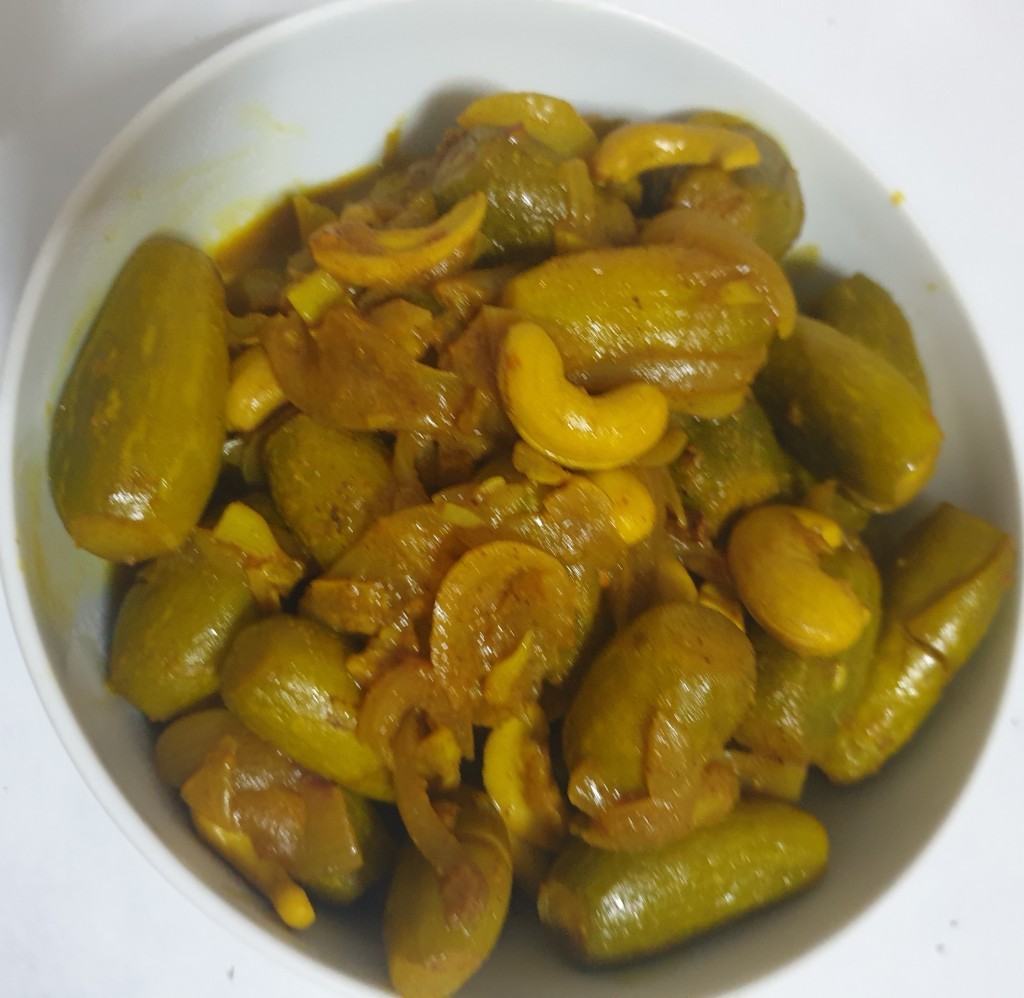
Tendli Miryapito


Tendli Miryapito

A traditional mangalorean style of cooking tendlis. Makes a nice addition to a festive or celebratory meal!

Tendli Miryapito – Tendli Jeere Meerem (Ivy Gourd/Tindoras)

Ingredients

  • ¼ Kg. Tendlis
  • 2 onions
  • 4 flakes garlic
  • 1/2 “ ginger (optional)
  • ½ cup cashewnuts (Moi) (soaked in water)
  • 1 tsp. Jeere Meerem powder
  • OR (jnstead of jeere Meerem powder)
  • ½ tsp. cumin powder
  • ½ tsp. pepper powder
  • ¼ tsp. turmeric powder
  • 1 tsp. salt
  • 2 tbsp. coconut or olive oil
  • ½ tsp. vinegar (optional)
  • ¼ tsp. sugar (optional)

Method

  1. Soak the tendlis in water and wash well. 
  2. Cut off the head and tail and smash the tendlis with a pestle with a light hand lest they get completely smashed. 
  3. Add the salt, masala powders, oil and mix well. 
  4. At this stage you can pre-prepare and keep aside till ready to cook or even keep in the refrigerator overnight. 
  5. Then add the chopped garlic, ginger (if using), sliced onion, add ½ cup water and cook till tender. 
  6. When cooked half way, add the cashewnuts and  mix. 
  7. Before taking off the fire add the vinegar and sugar and cook 5 minutes till water is almost absorbed. 
  8. If water dries up too quickly, add some more hot water and continue cooking. 
  9. Serve hot.

Mixed Vegetable Pulao


Mixed Vegetable Pulao

Using frozen mixed vegetables

Ingredients

  • 2 cups basmati rice
  • 1 cup frozen mixed vegetables
  • 1 medium onion, sliced
  • 2 stock cubes (chicken or vegetable)
  • 2to 3 sticks cinnamon
  • 5 cardamoms
  • 8 cloves
  • 2 tbsp. ghee
  • 4 cups hot water
  • ½ tsp. turmeric powder
  • ½ tsp. salt or to taste

Method

  1. Wash rice and soak in water for atleast 15 mns. 
  2. Heat a pot, add ghee and fry the onion, on medium flame. 
  3. Add the whole cinnamom, cardamom & cloves and saute till onion turns light brown. 
  4. Add the stock cubes and stir until it dissolves, add the frozen vegetable and saute for 2 minutes. 
  5. Add the drained rice and gently mix till the rice grains are coated with ghee and fluff up a bit. 
  6. Add the hot water, turmeric powder, optional if you want to leave the pulao white.
  7. Add salt to taste, it will already have some salt due to the stock cubes. Stir, bring to a boil. 
  8. Cover and reduce flame and cook. 
  9. Stir once in between to mix.
  10. Cook till water is completely absorbed. 
  11. Serve hot with raita, yogurt, pickle, dahi curry or at any festive meal.